
Her Africa · Dora Akunyili
The Woman Who Changed the Meaning of Public Service
The pharmacist who turned a government agency into the centre of a national fight against counterfeit medicine—and then carried that same sense of responsibility into public life.
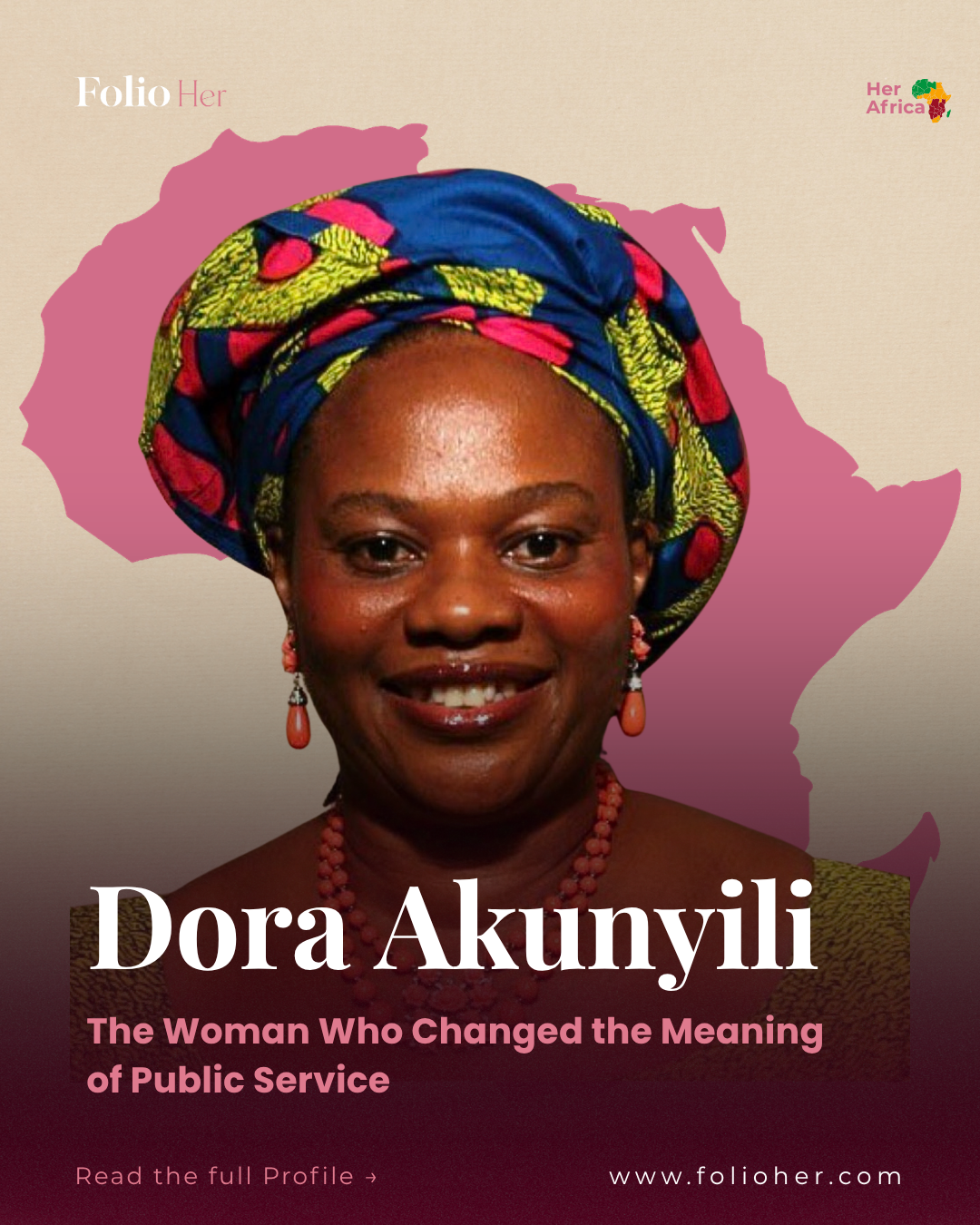
There was a time when Dora Akunyili was known primarily within the world of pharmacy.
She was a pharmacist, a pharmacologist, a teacher and a researcher. She had spent years in classrooms and laboratories, building a career at the University of Nigeria and eventually becoming a professor. Before the government position that would make her nationally famous, she had already lived several professional lives: hospital pharmacist, academic, researcher, consultant pharmacologist and public administrator.
Nothing about that early career suggested that she would eventually become one of the most recognisable faces of Nigerian public service.
Then came NAFDAC.
In 2001, President Olusegun Obasanjo appointed Akunyili Director-General of the National Agency for Food and Drug Administration and Control. She arrived at an institution that had a difficult reputation and a problem that extended far beyond regulation. Counterfeit and substandard medicines were circulating through the country, while corruption within the regulatory system itself made enforcement harder. The problem was not simply that dangerous drugs existed.
It was that an entire chain of people could profit from their existence.
Akunyili’s response was unusually direct.
She did not treat NAFDAC as an office whose primary responsibility was paperwork. Under her leadership, the agency became more visible, more aggressive in enforcement and much more present in public conversation. Officers inspected markets and points of entry. Counterfeit products were seized and destroyed. The agency published warnings and product information and used radio and television campaigns to teach Nigerians what counterfeit medicines could do to them. By 2006, Akunyili said the agency had secured convictions against dozens of counterfeiters.
But perhaps the more important battle was happening inside the institution itself.
She understood that an agency attempting to police a lucrative illegal trade could not function properly if its own officers were compromised. The World Health Organization reported that Akunyili dismissed corrupt officers and introduced measures intended to improve the morale, training and working conditions of the remaining staff. Reforming NAFDAC therefore meant confronting two problems at once: the people selling dangerous products and the weaknesses within the institution responsible for stopping them.
That distinction matters because Akunyili’s reputation was not built only on raids and seizures.
She made the counterfeit-drug problem difficult to ignore.
Her campaign brought an issue that had often remained inside the technical language of pharmaceutical regulation into ordinary Nigerian life. Radio jingles, newspaper notices and public warnings made counterfeit medicine something people were encouraged to recognise, question and report. The fight moved beyond laboratories and government offices and into markets, pharmacies and households.
There was a personal dimension to the work too. Akunyili had experienced the consequences of counterfeit medicine within her own family, an experience widely described as part of what strengthened her determination to confront the problem. But her tenure eventually became larger than that personal story. She was confronting an industry that could be extraordinarily profitable and a regulatory system that had to become strong enough to withstand it.
The resistance was real. In December 2003, gunmen opened fire on Akunyili’s convoy in Anambra State. She survived the attack. The incident came months after Transparency International had recognised her with its 2003 Integrity Award for her work confronting corrupt practices and counterfeit drugs.
The award itself revealed how far her work had travelled. A woman who had entered government as a pharmaceutical expert had become internationally recognised for the way she approached public administration.
But NAFDAC was not the whole of Dora Akunyili.
In 2008, she moved into another kind of public responsibility when she was appointed Minister of Information and Communications. The new position required a different skill from the one that had made her famous. She was no longer primarily regulating medicine or pursuing counterfeiters. She was now responsible for communicating government policy and speaking to a country that was often deeply sceptical of government itself.
She became associated with the Rebranding Nigeria campaign, an attempt to influence how Nigerians and the outside world perceived the country. The campaign attracted its own debates and criticisms, but it reflected something consistent in Akunyili’s public career: her belief that institutions and public figures had a responsibility to shape behaviour and public confidence rather than simply occupy their offices.
Her time in government also placed her in the middle of one of Nigeria’s more complicated political moments.
During the constitutional uncertainty surrounding President Umaru Musa Yar’Adua’s prolonged illness in 2010, Akunyili publicly took a position on the need for a clear transfer of authority. It was a departure from the safer language often associated with government ministers. Her decision contributed to the growing perception of her as a public official willing to speak beyond the boundaries of political convenience.
She eventually left the cabinet and entered electoral politics, contesting the Anambra Central senatorial election in 2011 on the platform of the All Progressives Grand Alliance. She did not win the election.
That chapter is worth remembering because it complicates the familiar image of Dora Akunyili.
She was not simply the NAFDAC woman who fought fake drugs. She was an academic who entered administration, a regulator who became a national communicator, a public servant who tried electoral politics, and later a delegate to Nigeria’s 2014 National Conference. Her career did not follow one straight line. It moved wherever she believed public responsibility required her next.
By the time she appeared at the National Conference, she was already seriously ill. Yet she participated as one of Anambra State’s delegates, returning to public work at a moment when the question of Nigeria’s future was once again being debated. She died on 7 June 2014, aged 59.
It is tempting to remember Akunyili through the most dramatic parts of her career: the fake drugs, the raids, the threats, the attack, the awards.
But the more revealing story is quieter.
She spent much of her life moving between systems that were supposed to serve the public, the university, a government trust fund, a regulatory agency, a ministry, a national political process—and repeatedly brought the same expectation to each one: that public work should have consequences for ordinary people.
That is what makes her career difficult to reduce to NAFDAC.
Dora Akunyili did not invent the problem of counterfeit medicine, nor did one administration eliminate it. The regulatory challenges she confronted did not disappear when she left office. Even the reforms associated with her tenure belonged to institutions larger than one person.
What she did was make the responsibility visible.
She made it harder to regard regulation as an abstract government function when the thing being regulated could determine whether someone lived or died. She made institutional corruption part of the same conversation. And she demonstrated, in a way that few Nigerian public officials have managed to do, how one person’s professional expertise could become a public cause.
The pharmacist, the professor, the regulator, the minister and the public servant were never really separate people. They were different expressions of the same career.
And perhaps that is the part of Dora Akunyili’s story worth carrying forward: not the mythology of a woman who single-handedly fixed a broken system, but the record of a woman who entered difficult institutions and insisted that the work inside them mattered.
Nigeria remembers her most vividly for the war she fought against fake drugs.
Her fuller legacy is the question underneath it:
What happens when someone decides that public service is not simply a position to hold, but a responsibility to be carried?