
ADEOLA ADEYEMI: WHEN BEAUTY BECAME A BUSINESS
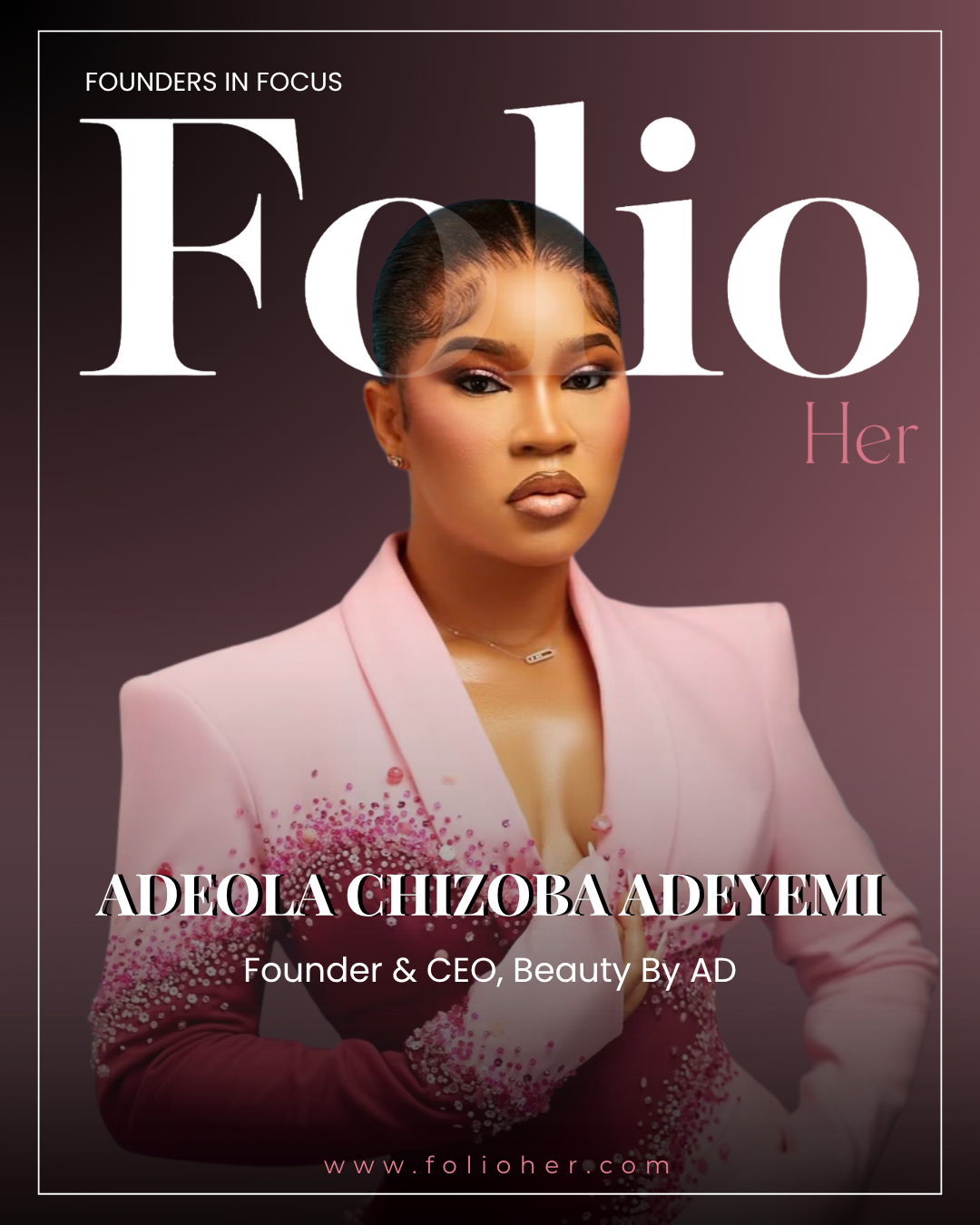
Adeola Chizoba Adeyemi knew the beauty industry before she ever owned a beauty company.
As a teenager, she was drawn to modelling and the visual language of fashion. She later worked as a video vixen, but the experience did not feel like the destination she had imagined for herself. She was interested in beauty in a more hands-on way, and eventually trained as a makeup artist at Make-Up Designory. That gave her a different relationship with the industry. She was no longer only observing beauty from the outside. She was working directly with products, faces, skin tones and the expectations women brought with them when they sat in her chair.
Adeola had always imagined having her own makeup line. But the decision to launch Beauty By AD in 2016 was not simply the natural next step for someone who loved makeup. By then, she had begun to notice gaps in the market that were difficult to ignore, particularly around the way beauty products served women with darker skin and different undertones.
She had seen the problem as a makeup artist. Building a company meant trying to solve it at another level.
That required her to move from knowing what women needed to figuring out how to make something that could consistently deliver it.
The early years were not presented as a straightforward success story. In a 2025 interview, Adeola described starting Beauty By AD with limited resources and no guarantee that the business would work. Her description of the biggest risk she took was simple: starting at all. She had to enter a competitive market and build consistency without knowing whether the investment would eventually translate into a brand people genuinely wanted.
That is one of the less visible changes that happens when a creative person becomes a founder.
As a makeup artist, the quality of your work can be seen on one face at a time. As the owner of a cosmetics company, the standard has to survive when you are no longer personally applying the product. It has to exist in the formula, the packaging, the customer experience and the expectations people carry when they see the name. Adeola understood early that this would matter.
In an earlier interview about the growth of Beauty By AD, she spoke about competition in the cosmetics market and identified quality and consistency as things the company could not compromise on. The packaging also had to be recognisable enough that customers could see a product and know where it came from.
Those details may sound ordinary until you consider what they represent.
A founder can have a compelling reason for starting a business. Customers, however, do not buy the reason. They buy the product.
So the work becomes translating conviction into something tangible.
For Beauty By AD, that meant creating products across different parts of the makeup routine while keeping the central question of representation in view. Adeola has described her goal as creating products that recognise the diversity of Black skin and give African women access to beauty products that feel both aspirational and relevant to them. That balance has become an important part of the brand.
Luxury can make a product desirable, but accessibility determines who gets to experience it. Inclusivity can be a marketing statement, but it means very little if the products do not actually work across the people they claim to serve.
Adeola has had to build with both questions in mind.
And somewhere along the way, Beauty By AD stopped being only about what was inside a compact or a tube.
In 2019, the company launched Face of Beauty By AD, a beauty-inspired modelling competition designed to give young women an opportunity to develop their careers in modelling. Adeola described it as a platform for aspiring models who needed not only visibility but structure and support behind the opportunity.
That move is revealing because it extends the logic of the brand beyond selling beauty.
Adeola had once been the young woman trying to find her own place within the fashion and beauty industry. Now she was creating a platform for other young women entering it.
The experience of building the company had therefore begun to change the question she was asking.
It was no longer only, “What product should we make?” It became, “What can this brand make possible?”
That thinking has continued into the Beauty By AD Academy, which Adeola discussed in 2025 as an initiative intended to give aspiring beauty professionals access to learning and guidance. She explained that the idea came partly from remembering what it felt like to have ambition without necessarily having enough direction around it. The academy had not yet begun classes at the time of the interview, but the intention was clear: to create another pathway for people trying to build careers in the industry.
There is a quiet progression in that.
A young woman develops an interest in beauty.
She enters the industry. She learns the craft. She notices what is missing.
She builds a product to address part of the gap.
Then, after years of building, she begins thinking about what other people might need in order to enter the same industry with more support than she had.
The company becomes part of a larger story. That does not mean the difficult parts disappear.
Beauty is an unusually personal business because the product is connected to how people see themselves. A bad product can disappoint a customer, but a product that does not understand the person using it can make her feel overlooked in a much deeper way.
For Adeola, that makes the question of representation more than a branding exercise.
She has described Beauty By AD as a brand intended to make African women feel seen, from the products themselves to the shade names, campaigns and wider storytelling around them. That also explains why the business has had to keep evolving alongside its customers.
The beauty consumer is not static. Neither is the African beauty market. Women are increasingly asking for products that work with their skin rather than asking them to adapt themselves to whatever happens to be available. Building a company in that environment requires listening closely enough to notice those changes without losing the reason the company existed in the first place. Adeola has now spent a decade doing that.
The public image of Beauty By AD is polished. The reality underneath it is much more ordinary: products that have to work, customers who have to trust the brand, teams that have to execute, decisions that cost money, competition that does not stop and a founder who has to keep making the next decision even when there is no guarantee that it will be the right one.
That is what separates having an idea from building a business around it.
Adeola’s own account of the early years captures something important about that transition. She did not wait until fear disappeared before she started. She started with limited resources and learned what the business required along the way. Years later, she still describes resilience as one of the qualities that has carried her through the process. There is also a different kind of confidence that comes from seeing customers choose something you created without being persuaded to do so.
Adeola has described seeing Beauty By AD products appear on shelves and in makeup kits, and watching them gain attention without her having to push every sale, as one of the moments when the business began to feel real. The significance was not simply that the products were visible. It was that people were beginning to choose the brand because they wanted it.
That is an important threshold for any founder.
At first, people may buy because they know you. Eventually, the work has to give them a reason to buy because they trust what you have built.
Adeola’s journey has been about making that distinction possible. She entered beauty because she loved it. She stayed because she saw an opportunity to make something better. She built because she believed African women deserved products that understood them. And as the company grew, the work began to ask her to think beyond the original product and about the people, systems and opportunities that could exist around it.
Beauty By AD is now the visible result.
But the more interesting story is what had to happen before the brand could become something other people could believe in.
Adeola had to move from being part of the beauty industry to taking responsibility for a piece of it.
That meant learning that passion could start the business but could not run it by itself. It had to be supported by quality, consistency, judgement, patience and the willingness to keep changing what needed to change.
Ten years after launching Beauty By AD, she is still building.
And perhaps that is the clearest measure of the journey: the girl who once wanted to create a makeup line now has to think about what an entire generation of women might need from the industry around it.
The business began with beauty.
The building has become about much more.